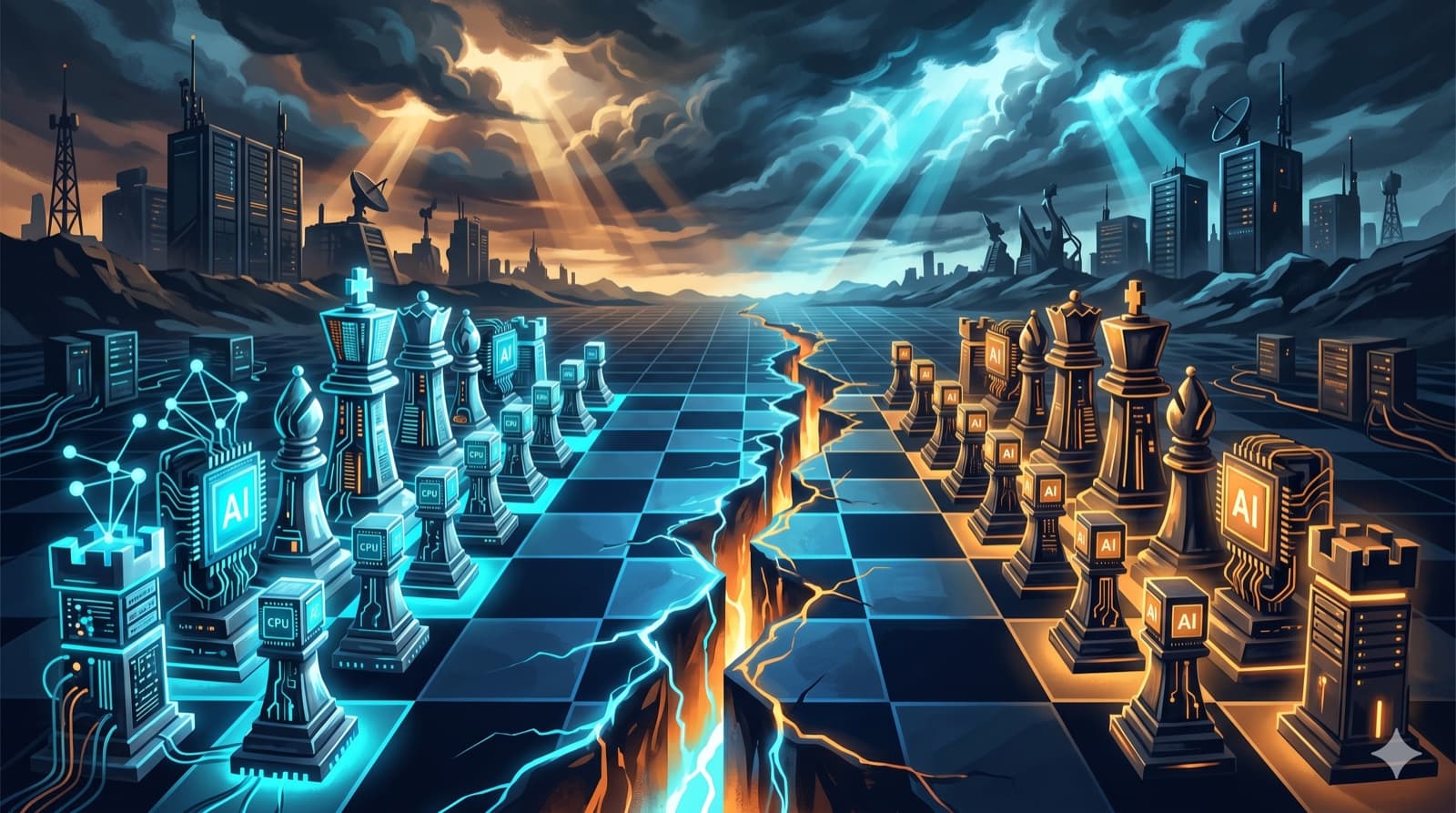

Anthropic recently introduced a new policy: under certain scenarios, using Claude requires uploading an ID document plus a real-time selfie for identity verification. China is in an uproar, with many people making a huge fuss.
Honestly, this is completely normal. From my perspective, this is already on the mild side.
This Was Never Peacetime
At the beginning of this year, my exact words to the team were: we can still use overseas models right now, so don't get hung up on money or account issues—just start using them. Master the feel and methodology of collaborating with AI first. In as little as three months, you'll start running into problems; you might not be able to use them anymore. You must adopt this mentality of urgency.
Since 2023, the AI industry has been in a state of war.
Look, when ChatGPT launched in 2023, GPT-3.5 was free, but China's IPs were blocked from Day 1. You needed an overseas phone number just to register a free account, and China directly blocked it on its end as well. Things never loosened up after that—only got tighter.
In September 2025, Anthropic officially announced a ban on all "China-controlled companies" from using Claude services—no matter where you operate, if over 50% of your equity is controlled by Chinese entities, you're denied access. That November, mass account bans began. By February 2026, things became even more direct: Anthropic publicly accused three Chinese AI companies—DeepSeek, Moonshot AI, and MiniMax—of distilling the Claude model through approximately 24,000 fake accounts, generating over 16 million conversations in total.
Just a few days ago, Peter Steinberger, founder of OpenClaw, also had his account banned. It wasn't targeted at him; most likely an anomaly detection false positive, and it was later restored. But incidents like this make people panic.
So I'm telling you, don't be shocked. The intent of these model companies hasn't changed since Day 0—they've been blocking you by every means possible. But mass bans lead to false positives, and false positives require appeal processing. Their infrastructure is under heavy pressure too; how many people do they even have managing this? Real-name verification is actually a fallback compromise.
Chips and Models: Two Sides of the Same Coin
The chip side is also a constant battle.
In January 2025, the U.S. Department of Commerce's Bureau of Industry and Security issued new rules, completely choking off exports of NVIDIA's flagship GPUs like the H100 and H200 to China. In April, even compliance chips were banned. In July, the H20 was quietly unblocked, on the condition that NVIDIA hand over 15% of its revenue to the U.S. government. In December, they simply unblocked the previously banned H200 too, this time taking 25%. Huawei's chips were also banned by the U.S. in retaliation. Back and forth.
The model side is the same. In February 2025, the U.S. Congress proposed the "No DeepSeek on Government Devices Act," prohibiting federal employees from using DeepSeek on government devices. Subsequently, multiple federal agencies including the Department of Commerce and the Navy, as well as states like New York, Tennessee, and Virginia, followed suit.
Chips and models are two sides of the same coin; there's no getting around that.
AI Is Already on the Battlefield
Many people may not have noticed, but AI is already being deployed at scale on real battlefields.
Israel deployed an AI system called "Lavender" during the Gaza war, integrating signals intelligence, imagery intelligence, human intelligence, and spatial intelligence to generate a target list of 37,000 individuals. Many of them were low-ranking members, some without even confirmed military roles. By March 2024, the Israeli military's usage of Microsoft and OpenAI technical tools had increased nearly 200-fold compared to the week before October 7. Microsoft Azure usage surged 60% during the first six months of the war.
In March 2026, the U.S. military publicly confirmed the use of "advanced AI tools" in military operations against Iran. Admiral Brad Cooper's exact words were that AI is "compressing the time between detection, decision, and action," fusing data from satellites, drones, electronic intelligence, and battlefield sensors into a real-time operational picture.
Look at the AI companies. In February 2026, OpenAI secured a $200 million Pentagon contract. Palantir is even more extreme—in August 2025, it landed a $10 billion, 10-year software contract with the U.S. Army, and by March 2026 its Maven smart system was officially designated as a core system for all five branches of the military.
What about Anthropic? Because it refused to allow its models to be used for mass surveillance and autonomous weapons systems, it was directly designated a "supply chain risk" by the Trump administration, stripped of all military contracts, and all defense contractors were required to stop using Anthropic's AI models.
You see, it's a militarily-grade advanced productive resource. While transforming social productivity, it's also being directly used for warfare.
It's Too Similar to the Qing Dynasty During the Industrial Revolution
When productive forces undergo massive transformation, the relations of production must follow. Once the relations of production change, power gets reshuffled. This has happened every time in history.
The current situation is too similar to the Qing Dynasty during the Industrial Revolution. Other countries were undergoing massive changes in warships and artillery, financial systems, and industrial manufacturing, while over here we were still discussing: Is this a bubble? How does this help daily life?
There's nothing wrong with these discussions. But everyone knows what happened next: others' cannons blasted open your doors, followed by burning, killing, and looting. For our country, this was only a century or two ago—textbooks lay it out clearly.
The data tells the story too. During the Kangxi and Qianlong eras, China's GDP accounted for roughly 35% of global output; by 1820 it was still 32.9%, making it the world's largest economy, not just one of the largest. Then the Opium Wars came, and by 1870 it had shrunk to less than half of Western Europe's.
The wealthiest country in the world, lacking advanced technology and military force, ended up being attacked at its doorstep.
But thanks to the efforts of countless people over the past century or two, today's China is in a completely different state from the Qing Dynasty back then.
The current situation more closely resembles the 17th-century rivalry between Britain and the Netherlands. At the time, the Dutch had Europe's largest merchant fleet—more ships than all other countries combined—and controlled the spice trade in the East Indies, a commercial hegemon. Then Britain caught up, enacted the Navigation Acts in 1651, and went straight to war: four Anglo-Dutch Wars in total. Two major powers of similar stature fought from trade to military affairs, neither able to eliminate the other, for nearly a century.
Today's AI competition between China and the U.S. feels exactly like that. Stanford's 2026 AI Index report states it clearly: the gap between top U.S. and top Chinese models has narrowed to just 2.7 percentage points; in 2023, that gap was still 17 to 31 percentage points. DeepSeek R1 briefly caught up to the strongest U.S. model in February 2025. China holds roughly 70% of global AI patents, and accounts for 23.2% of paper output. Looking beyond AI, over 60% of global new energy vehicles are made in China; BYD surpassed Tesla in March 2025 to become the world's largest manufacturer, and industrial robot installations account for over half the global total.
This is an entirely different matter from the Qing Dynasty being crushed. This is two comparable major powers competing head-to-head. But precisely because they are close, the competition is fiercer. Britain and the Netherlands fought four wars over a century. Today's chip bans, model blockades, and military contract battles are this era's Navigation Acts.
So back to AI models. The new Claude Mythos model—Anthropic isn't opening it to the public at all, sharing it only with Microsoft, Apple, Amazon, and Google through the Project Glasswing initiative. Why? Because during internal testing, this model autonomously discovered and exploited zero-day vulnerabilities in all major operating systems and browsers, including a 27-year-old OpenBSD vulnerability and a 16-year-old FFmpeg vulnerability.
The signal is obvious. In certain domains, AI is increasingly being positioned closer to nuclear weapons.
From World War II to today, the world is still fighting over who should and shouldn't have nuclear weapons. Won't the same happen with AI? Absolutely.
This Wave Is One Ordinary People Can Join
However, there is one very different aspect from before: the barrier to participation has been lowered.
During the Industrial Revolution, what could ordinary people do? Donate money. The Self-Strengthening Movement, the Beiyang Fleet—most people could only watch from the sidelines.
Now it's different. Every ordinary person can take a top-tier AI model and participate in creation. You can even target a very complex system, contribute your ideas, and build it directly.
Imagine three years from now. Country A has 2 million heavy AI users out of 10 million people, with widespread AI adoption in national development. Country B also has 10 million people, but only 1,000 are using it. The productivity gap will be terrifying.
After the Industrial Revolution, the West massively popularized mathematics and science education, turning the population into a new industrial productive force. In some countries, a million people received this education and could participate in industrial construction and manufacturing; in others, only a hundred. When national strengths truly collide, the gap becomes apparent. Moreover, cultivating people takes time. When you need talent but can't recruit it, that's when real problems arise.
Participate If You Can
So back to the original topic. Anthropic implementing real-name verification? Completely normal.
If you can use it, use it discreetly and see what's happening abroad. Domestic models are actually not bad now either; I spend quite a bit every month on subscriptions for domestic large models. No VPN needed, no account hassles—just a straightforward commercial service, very comfortable. The reason people bother with overseas ones is because the quality is higher, right? At the end of the day, isn't it because their stuff is currently more advanced?
In this environment, rather than thinking about how to participate and contribute, or how to become self-reliant and stronger, spending every day obsessing over who's blocking you next—there's no point in that.
Blockades can never seal everything off. Where there's market demand, there will be gaps. Just like those Bitcoin scenarios requiring real-name verification—a bunch of people ran to Africa with sacks of cash, two brothers with AK-47s standing behind them, getting locals to provide identities. Quite a vivid image.
But what really deserves reflection is: in this situation, shouldn't we realize that in the AI field, at least, we are already in a state of war? The international situation has never been peaceful; stop thinking about your own participation with a peacetime mindset.
It's like playing an RTS game. Early on it's peaceful development—spam workers, tech up. But by the mid-game, everyone starts fighting. You can't just focus on development; survival comes first. If you don't have troops, you're done when others attack. The Qing Dynasty held one-third of global GDP, the wealthiest country, but without technology or military force, it still got attacked at its doorstep.
Backwardness invites beatings. This is very recent history, not that long ago.
I've always believed: don't make the result your goal. Results are what naturally follow when you get the direction right. Study hard and good grades follow naturally; study for the sake of grades and you'll definitely suffer.
In this era, go do meaningful things, participate, think about what you can contribute. Don't keep staring at results—you can't control those.
References
- Anthropic Identity Verification Policy — Launched April 15, 2026; requires passport/driver's license/ID card + real-time selfie, processed by Persona Identities
- Anthropic Bans China-Controlled Enterprises from Using Claude — September 2025; prohibits enterprises with over 50% equity controlled by Chinese entities from using the service
- Anthropic Accuses Chinese AI Companies of Distilling Claude Using Fake Accounts — Accused DeepSeek, Moonshot AI, and MiniMax of generating over 16 million conversations through approximately 24,000 fake accounts
- Anthropic Temporarily Bans OpenClaw Founder — Peter Steinberger temporarily banned for "suspicious activity" and later restored
- U.S. AI Chip Export Control Timeline — From full H100 sales ban to conditional H20 unblock to H200 unbanning (January–December 2025)
- "No DeepSeek on Government Devices Act" — Proposed February 2025; prohibits federal employees from using DeepSeek on government devices
- U.S. Military Confirms AI Use in Operations Against Iran — March 2026
- Israeli AI Military System "Lavender" — Integrated multi-source intelligence to generate a 37,000-person strike target list
- Microsoft/OpenAI Tools Massively Used by Israeli Military — Usage frequency increased nearly 200-fold by March 2024
- OpenAI Secures $200 Million Pentagon Contract — February 2026
- Anthropic Designated "Supply Chain Risk" by Trump Administration — For refusing to allow models to be used for mass surveillance and autonomous weapons
- Palantir $10 Billion Army Contract and Maven System — Signed August 2025; became a core military system across all branches in March 2026
- Qing Dynasty GDP Share of Global Output — Approximately 35% during the Kangxi and Qianlong eras, 32.9% in 1820, sharply declining after the Opium Wars
- Claude Mythos Model Restricted Release — April 2026; restricted to Project Glasswing alliance companies due to security concerns such as autonomously discovering zero-day vulnerabilities
- 80% of U.S. AI Startups Use Chinese Open-Source Models — U.S.-China Economic and Security Review Commission report, March 2026
- Stanford 2026 AI Index: China-U.S. Gap Narrows to 2.7% — DeepSeek R1 briefly caught up to top U.S. models; China holds 70% of global AI patents, 23.2% of paper output
- China Becomes World's Largest AI Patent Holder — WIPO data; China holds approximately 60–70% of global AI patents
- 17th-Century Anglo-Dutch Wars and Commercial Competition — Four Anglo-Dutch Wars; two similarly matched powers competed for nearly a century over trade and maritime supremacy
- BYD Surpasses Tesla to Become World's Largest EV Manufacturer — March 2025; China produces over 60% of global electric vehicles